Blog ·
How to prove a car's service history when you sell it
A buyer standing next to your car cannot check whether it was looked after. Everything you say about servicing is a claim until something backs it up. This is what actually backs it up, and how to put it in front of them in one document.
What the buyer is actually asking
Nobody wants a folder. What a buyer wants to know is narrower than that, and it comes down to three questions:
- Was it looked after on time? Not whether it visited a dealer, but whether the things that destroy engines and gearboxes were done at roughly the right intervals.
- Is anything being hidden? A missing year is read as a bad year, whether or not it was one.
- Does the story hold together? Dates, odometer readings and the work described have to fit each other. Mileage that stands still for two years and then jumps invites a very different negotiation.
Answer those three and you have removed the doubt that otherwise turns into a discount. That is the honest promise of a service history: it does not add value out of thin air, it stops value leaking out during the conversation.
Why a dealer stamp book is only half the record
Two things routinely never reach a stamp book or a vehicle-history report, and neither of them means the car was neglected.
Independent garages. A local specialist does the timing belt properly and issues an invoice. Whether that ever appears in a database depends on whether the garage reports anywhere, and most do not.
Work you did yourself. If you change the oil in your own garage, there is no invoice at all — there are two receipts, for oil and a filter, and your memory. A history report on that car shows nothing where the work happened, which is exactly why owners who maintain their own cars are the ones most often accused of not maintaining them.
Vehicle-history services are useful for what they do see: registrations, write-offs, finance, plate changes, mileage recorded at inspections. They cannot see what nobody reported to them. For that half of the record, the owner is the only source there will ever be — so it is worth being a good one.
The documents that answer the question
| What you keep | What it proves |
|---|---|
| Workshop invoices | The work, the date, the odometer and who did it |
| Parts and fluid receipts | The only evidence that exists for work you did yourself — keep the specification, not just the price |
| Photos of the odometer | A mileage line that moves plausibly, and the reading at each service |
| Inspection and emissions certificates | Independent confirmation of the state of the car on a date |
| Insurance and tax documents | That the car was in use rather than standing untaxed for a year |
| Anything that came with the car | The history before you, and where your part of it starts |
A photograph of a receipt is worth more than a note about it, and both are worth more than nothing. Take the photo when the paper is in your hand; it is the one moment when the effort is close to zero.
How to put it in front of a buyer
- One chronological document, not a folder. Dates ascending, with the odometer next to each entry. The folder can come out afterwards, for the entries someone wants to see behind.
- Leave the prices out. What you paid is your business, and a bill for a timing belt is an invitation to argue about the price of a timing belt. The buyer is owed the care taken, not the sums.
- Do not print the full VIN or plate. The last four characters of the VIN are enough for anyone to match the document against the papers in the car. A complete VIN plus a plate in a stranger's photo is enough to order duplicate documents or pull reports in your name.
- Say what the document is. "These are my own records kept during ownership" is a stronger sentence than an implied claim of verification, because the second one collapses the moment it is questioned.
- Explain the gaps instead of hiding them. "Nothing here for 2024 — the car was off the road while I was abroad" closes a question. A silent gap opens one.
What not to do
Do not reconstruct records you have no evidence for. A tidy list assembled from memory the week before a sale reads as exactly that, and one entry the buyer can disprove costs you the credibility of every other entry. An honest short history beats an impressive invented one.
And do not describe your own records as verified, certified or checked. They are first-hand and they are yours; that is a real thing and it does not need borrowed authority.
Doing this with Bortio
Full disclosure: I build Bortio, so read this section as what it is — the tool I made for this job, described by the person with an interest in it.
Bortio keeps the servicing, expenses, mileage and documents of a vehicle as one history on your phone, and prints a one-page vehicle passport out of it when the car changes hands. Here is the actual sample the site publishes, not a mockup:
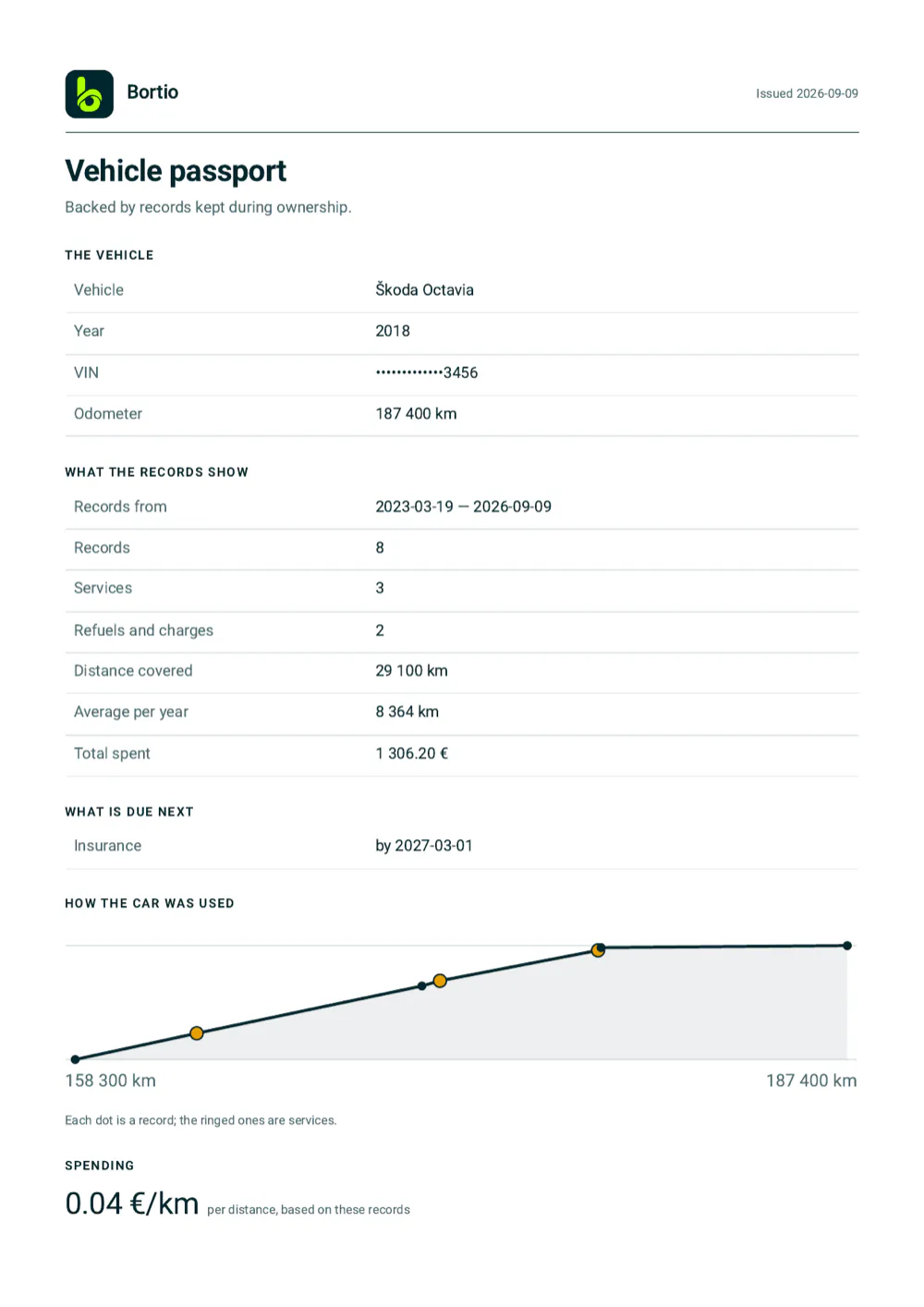
The published sample, with prices switched on to show the option. Open the sample passport (PDF).
What the page carries, in the sample above: the vehicle and the last four VIN characters, the period the records cover (2023–2026), how many records and services stand behind it, the distance those records prove, what falls due next, and then the service history itself — date, type, what was done, odometer, and the amount where amounts are included. One of its lines reads "Timing belt and water pump · Independent garage", which is the case this whole article is about.
Three of its defaults are the argument, not the features:
- Prices are excluded unless you switch them on. The sample has them on so you can see what they look like; the document you hand over does not, unless you decide otherwise.
- The VIN shows its last four characters. Enough to match the paper in the glovebox, not enough to act on.
- It is made on the phone. No account, no upload, no internet — the records are on your device and the document is printed there.
Records can also carry where they came from: entered by you, backed by a document you attached, read from a photo of a receipt, or received with the car from the previous owner. That distinction is the difference between a list and evidence, and it is the reason the passport can say plainly that it is owner-kept rather than independently verified.
Bortio is free with one vehicle, and available for Android now; the iPhone version is still in development.

On iPhone? Join the launch list — one email when the iPhone version ships, and nothing else.
If you are buying rather than selling
Ask for the history in writing and read the shape of it, not only its length. Continuity matters more than volume: six years of modest, regular entries say more than a burst of expensive work just before the sale. Check that odometer readings rise sensibly between entries, and take the glovebox folder with the car — it becomes the beginning of your own record, and the dates in it stay where they belong.
Questions people ask
Does a documented service history make the car sell for more?
It is more honest to say that missing history costs you money than that present history earns it. A buyer discounts uncertainty, and a complete record removes the uncertainty; whether that shows up as a higher price or a faster sale depends on the car and the market.
What if I did all the work myself?
Then you are the only record that exists, and receipts for parts and fluids plus dated odometer readings are your evidence. Note the specification you used, not just the amount you paid — "5W-30, long-life spec, filter changed" is what a careful buyer wants to read.
Is a printed history enough, or do I need dealer stamps?
Stamps are one form of evidence, not the definition of one. Invoices from independent garages, parts receipts and consistent mileage are evidence too. What convinces is the chain of dates and documents, not the logo on the page.
Should I include what I spent?
Usually not. Costs are useful to you while you own the car, for working out what it really costs to run — there is a calculator for that on this site. At the point of sale they mostly move the conversation onto the wrong subject.
Related on this site
- Free car maintenance log template — a printable table if you want to start on paper today.
- Car cost calculator — what the car costs per month and per kilometre, with lost value kept separate from money spent.